The Liberating Body of Christ
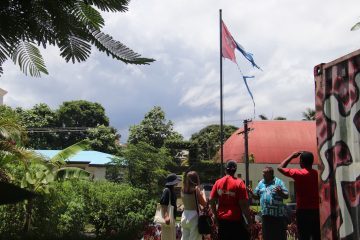
FREEDOM Sunday in the Pacific is a day when churches gather to pray for peace and justice, particularly in Bougainville, Kanaky, Maohi Nui and West Papua – territories in which the majority of people still yearn for political self-determination.
This year the day falls on December 15, 58 years and 14 days since the Netherlands granted political freedom to West Papua which was then part of the Dutch East Indies. We remember that as a free people, the churches of West Papua helped create the Pacific Conference of Churches.
More recently, Freedom Sunday provides a time for churches to reflect on, pray for and take action on the issue of modern-day slavery which has crept slowly but surely into the region and the Pacific diaspora in Australia, Europe, New Zealand and the United States.
Let us pray today for all those who seek liberty – political, financial, psychological – and remember that we cannot be truly free until all people are free.
Freedom was mandated by the PCC General Assembly in Honiara in 2013.
Freedom Sunday 2019 – Scripture Texts:
Exodus 3:7-10 New International Version (NIV)
7 The Lord said, “I have indeed seen the misery of my people in Egypt. I have heard them crying out because of their slave drivers, and I am concerned about their suffering. 8 So I have come down to rescue them from the hand of the Egyptians and to bring them up out of that land into a good and spacious land, a land flowing with milk and honey—the home of the Canaanites, Hittites, Amorites, Perizzites, Hivites and Jebusites. 9 And now the cry of the Israelites has reached me, and I have seen the way the Egyptians are oppressing them. 10 So now, go. I am sending you to Pharaoh to bring my people the Israelites out of Egypt.”
Psalm 130
A song of ascents.
1 Out of the depths I cry to you, Lord;
2 Lord, hear my voice.
Let your ears be attentive
to my cry for mercy.
3 If you, Lord, kept a record of sins,
Lord, who could stand?
4 But with you there is forgiveness,
so that we can, with reverence, serve you.
5 I wait for the Lord, my whole being waits,
and in his word I put my hope.
6 I wait for the Lord
more than watchmen wait for the morning,
more than watchmen wait for the morning.
7 Israel, put your hope in the Lord,
for with the Lord is unfailing love
and with him is full redemption.
8 He himself will redeem Israel
from all their sins.
1 Corinthians 12:12-27 New International Reader’s Version (NIRV)
One Body but Many Parts
12 There is one body, but it has many parts. But all its many parts make up one body. It is the same with Christ. 13 We were all baptized by one Holy Spirit. And so we are formed into one body. It didn’t matter whether we were Jews or Gentiles, slaves or free people. We were all given the same Spirit to drink. 14 So the body is not made up of just one part. It has many parts.
15 Suppose the foot says, “I am not a hand. So I don’t belong to the body.” By saying this, it cannot stop being part of the body. 16 And suppose the ear says, “I am not an eye. So I don’t belong to the body.” By saying this, it cannot stop being part of the body. 17 If the whole body were an eye, how could it hear? If the whole body were an ear, how could it smell? 18 God has placed each part in the body just as he wanted it to be. 19 If all the parts were the same, how could there be a body? 20 As it is, there are many parts. But there is only one body.
21 The eye can’t say to the hand, “I don’t need you!” The head can’t say to the feet, “I don’t need you!” 22 In fact, it is just the opposite. The parts of the body that seem to be weaker are the ones we can’t do without. 23 The parts that we think are less important we treat with special honor. The private parts aren’t shown. But they are treated with special care. 24 The parts that can be shown don’t need special care. But God has put together all the parts of the body. And he has given more honor to the parts that didn’t have any. 25 In that way, the parts of the body will not take sides. All of them will take care of one another. 26 If one part suffers, every part suffers with it. If one part is honored, every part shares in its joy.
27 You are the body of Christ. Each one of you is a part of it.
Matthew 5:1-11 New International Version (NIV)
Introduction to the Sermon on the Mount
5 Now when Jesus saw the crowds, he went up on a mountainside and sat down. His disciples came to him, 2 and he began to teach them.
The Beatitudes
He said:
3 “Blessed are the poor in spirit,
for theirs is the kingdom of heaven.
4 Blessed are those who mourn,
for they will be comforted.
5 Blessed are the meek,
for they will inherit the earth.
6 Blessed are those who hunger and thirst for righteousness,
for they will be filled.
7 Blessed are the merciful,
for they will be shown mercy.
8 Blessed are the pure in heart,
for they will see God.
9 Blessed are the peacemakers,
for they will be called children of God.
10 Blessed are those who are persecuted because of righteousness,
for theirs is the kingdom of heaven.
11 “Blessed are you when people insult you, persecute you and falsely say all kinds of evil against you because of me.
Sermon notes for Freedom Sunday 2019:
The readings today connect in the theme of liberation.
The story of the Exodus is the story of God’s liberating presence. God hears the cries of the oppressed and calls Moses to be his agent of liberation, to lead the people out of bondage to a predatory system of economic extraction. The people are oppressed, existing only as cogs in the machinery of the Egyptian economy. “I have indeed seen the misery of my people in Egypt. I have heard them crying out because of their slave drivers, and I am concerned about their suffering. So I have come down to rescue them from the hand of the Egyptians and to bring them up out of that land into a good and spacious land, a land flowing with milk and honey (Ex 3: 7-8). In the context of the ongoing colonization in the Pacific, West Papua (Papua/Irian Jaya), Maohi Nui (French Polynesia) and Kanaky (new Caledonia), the people may not be enslaved in another land, but it is their land, their identity, their very souls that have enslaved – through cultural, social, economic and political oppression and colonisation. The land and sea, which form an integral part of the Pacific Islander identity has been enslaved and is being extracted for profit by France (in the case of Maohi Nui and Kanaky). Their home, their vanua, fenua, land; their sea, moana, solwara, qoliqoli and wasawasa; is not milk and honey for them. That milk and honey is being extracted and exported with little or no benefit for the indigenous people. They are the beggars forced to sit and wait for crumbs.
Kanaky (New Caledonia)
Kanaky was annexed by France in 1853, mainly for the use as a penal colony. In three decades after 1860 more than 40,000 prisoners—including political exiles—were deported to the colony.
In Kanaky, nickel is extracted and shipped to many Asian countries where it is processed to manufacture steel, electronics and consumer goods. The nickel industry has made many Caldoche wealthy, with minerals for 90 percent of the territory’s export revenue. This makes money for France, for French settlers, but not for indigenous Kanaks. There will be a second referendum on Independence in 2020 after a narrow loss by pro-independence movement in the 2018 referendum.
Maohi Nui (French Polynesia)
Maohi Nui, apart from the vast ocean resources for France, was the site of atomic bomb tests for 30 years. Between 1966 and 1996, France conducted 179 nuclear weapons tests at Moruroa Atoll (42 atmospheric; 137 underground) and 14 at Fangataufa Atoll (4 atmospheric; 10 underground) in French Polynesia/Te Ao Maohi. The nuclear explosions, each 150 times more powerful than the atomic bomb detonated in Hiroshima in World War Two, contaminated marine environments and may have increased the incidence of thyroid cancer in the local population, mainly as a result of contaminated of the food and water supply. The tests damaged the atolls themselves; there is an ongoing threat of collapse or leakage of radioactive contamination. Radioactive particles were dispersed over much of Maohi Nui, including its most populated island, Tahiti. Recent reports show that as a result of the tests, the atoll of Mururoa is about to crack apart, releasing more radioactive waste into the Pacific. Veterans of the tests and their families still struggle for compensation by the French government. Maohi Nui was relisted on the UN Decolonisation list, but with opposition from France, this is a difficult path to Self Determination.
Tanah Papua (West Papua)
West Papua, annexed by Indonesia remains the most oppressed Pacific Island community, suffering structural violence and institutional racism, gross human rights abuses by the Indonesian military, denial of the opportunity for free, prior and informed consent of indigenous customary landowners for any extraction/development projects, lack of adequate services by the state and suppression of cultural, social and economic rights.
In February this year, the World Council of Churches took the largest-ever delegation visit to West Papua and raised serious concerns over the continued systematic marginalisation of the West Papuan people. The World Council of Churches visited West Papua and learnt of the displacement of a growing number of people from remote communities, in response to the perceived threats from Indonesian authorities in the region.
On February 21 of this year, the largest group of independent experts within the UN human rights system issued an unprecedented statement condemning a ‘culture of impunity’ around human rights abuses in West Papua. The statement calls for ‘those who have committed human rights violations against the indigenous population of Papua’ to be ‘held to account’.
In March this year, of the U.S. State Department released annual ‘country reports’ on local human rights in Indonesia. The report detailed arrests of self-determination advocates, targeting of local NGOs operating in West Papua and intimidation of the press. The report also notes the severe and widespread violations of the cultural, social and economic rights of Indigenous West Papuans.
Together, the World Council of Churches visit and the US State Department report show evidence of the serious human rights abuses that are taking place in West Papua even though Indonesia is a party to all major International human rights conventions, including the International Covenant on Civil and Political Rights and the International Covenant on Economic, Social and Cultural Rights.
In August and September this year, institutional racism towards West Papuans erupted in violence towards West Papuan students in Indonesia, labelled, “Monkeys,”which resulted in protests in Papua and an unprecedented increase in violence from Indonesian migrant militias and increase in military deployment, and extra judicial killings.
A combined report by Papuan local human rights NGOs, churches and the Nduga Regency administration on conflicts between Indonesian Military and armed indigenous groups in the Nduga region found that close to 200 Papuans, mostly women and children had either been killed or died fleeing the conflict and with 45,000 currently displaced as a result of the conflicts.
None of us can speak of an inclusive and peaceful Pacific and remain silent on the serious human rights issues for West Papuans.
In the darkness of depths of oppression, the Psalmist calls out to God for mercy, for liberation. God’s unfailing love and liberation is a source of hope. This hope is part of the hope that is at the core of the season of Advent, the hopeful anticipation of not just the incarnation of God, but what that incarnation means: the presence of the liberating Christ. For sisters and brothers in Kanaky, Maohi and West Papua, it is the hopeful anticipation of liberating through Self-Determination as indigenous Pacific islanders.
St. Paul reminds us that we are that Body of the Liberating Christ and the Body of the oppressed. As he writes, “We were all baptized by one Holy Spirit. And so we are formed into one body. It didn’t matter whether we were Jews or Gentiles, slaves or free people. We were all given the same Spirit to drink… If one part suffers, every part suffers with it. If one part is honoured, every part shares in its joy. You are the body of Christ. Each one of you is a part of it.”
In the context of our Pacific Family, to call our Melanesian sisters and brothers in West Papua ‘Monkeys’ is to call all Pacific Islanders ‘Monkeys’. Anglican priest, Father Walter Lini, the first Prime Minister of Vanuatu, said when Vanuatu became Independent, “Vanuatu and the Pacific will only truly be free when West Papua and Kanaky and others are free.”
In the Beatitudes we are reminded that those of us who wish to be a child of God are called to make peace and stand for justice, regardless of the personal cost.
Here is another version of the Beatitudes for us to consider:
You are blessed when you discover a simplicity and poverty of spirit, for there you will also find the riches of my kingdom.
You are blessed when you mourn, for in the midst of bearing the painful cross of grief, I do walk with you, perhaps unrecognised, but always there to comfort you.
You are blessed when you live in humility, for by doing so become united with all my children and my whole creation and the earth will be your inheritance.
You are blessed when you long for and cry out for justice to be done, have faith that the Justice of my kingdom is coming and will not leave you unfulfilled.
You are blessed when your actions show kindness and mercy, for in living so you will receive kindness and mercy in return, and if not always from others, you will from me.
You are blessed when you seek me with all your heart, for I will honour your spiritual searching and you will see me face to face and heart to heart.
You are blessed when you make peace in the world, in doing so you become my beloved children.
You are blessed when you suffer in the cause of right, for each act of justice, no matter how painful or difficult, helps to build my kingdom.
You are blessed when people revile you, persecute you, hate you and lie about you falsely because of your belief in me, they treated my prophets like this, they even treated Jesus like this, so find joy in the fact that you are in good company, and my heaven is yours.
Sisters and brothers in Christ, this Freedom Sunday, we are called to ask ourselves whether are truly living as part of Body of Christ and as part of the family of a God who is committed to liberating the oppressed and speaking truth and justice for the vulnerable.
Intercessory Prayers:
Presider: God pf mercy, peace and love – we gather before you as one people, created in your image. Listen to or prayers, we humbly pray, and help us to be instruments of freedom in a world imprisoned by anger, hatred, greed and intolerance. Lord, hear us.
Response: Lord, hear our prayer.
Presider: We pray for our brothers and sisters in Bougainville, Kanaky, Maohi Nui and West Papua. May they come to know the joy of liberty and freedom from the yoke of bondage. Lord, hear us.
Response: Lord, hear our prayer.
Presider: For legislators and those in positions of authority. Grant them clarity of mind and conscience to create laws which bring justice to all who live in oppression. Lord, hear us.
Response: Lord, hear our prayer.
Presider: We pray for women and children and all who suffer from violence and discrimination. May they find comfort and protection. And may men of integrity rise in our communities to defend the weak and downtrodden. Lord, hear us.
Response: Lord, hear our prayer.
Presider: For our young people. That they may grow in spirit and truth, united in your love and in their love for you. May they be instruments of enduring liberty and creators of communities of tolerance and understanding. Lord, hear us.
Response: Lord, hear our prayer.
Presider: We pray for nations, torn apart by difference of race, religion and politics. Help us to bring about unity through the love of Christ given freely to all and the spirit of God which created us all. Lord, hear us.
Response: Lord, hear our prayer.
Presider: All powerful and ever living God, listen to these our prayers, the cry of your proplr for freedom from oppressive governments, thoughts and beliefs. Strengthen us to work together for peace and harmony so that we may become one people, worthy of your love. We make this prayer through Christ our Lord.
Response: Amen
 English
  French
0 Comments